India’s 600th Test: The Extraordinary Journey from Lord’s 1932 to Galle 2026
AGArpan Ghosh
· 5 min read
· 91 views
Updated
Share
From C.K. Nayudu leading India at Lord’s in 1932 to Shubman Gill leading the country into its 600th Test in Galle, Indian cricket’s longest journey has been built on patience, setbacks, triumphs and generations of unforgettable players.
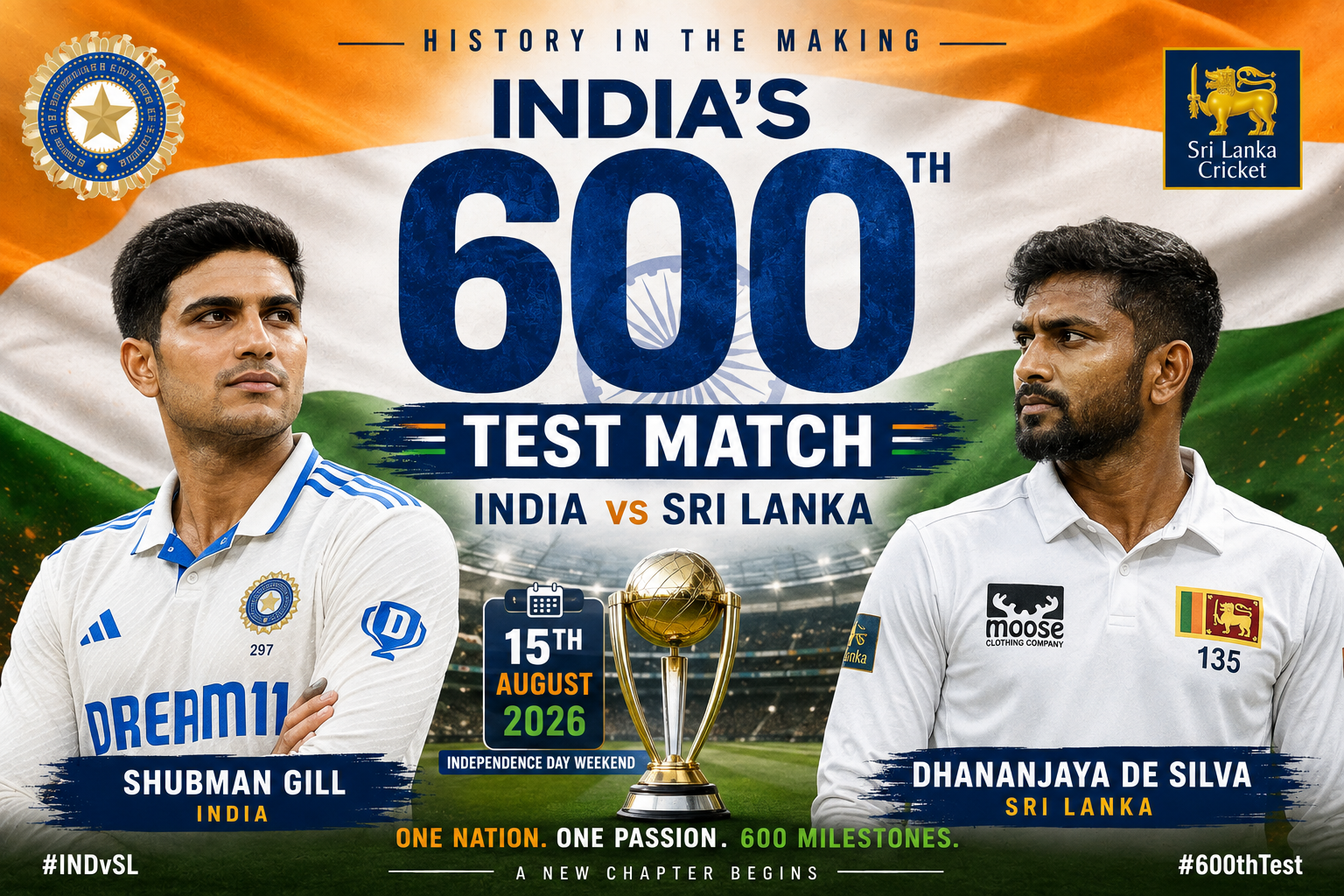
On 15 August 2026, Indian cricket will reach a landmark that once seemed almost unimaginable. India will play its 600th men’s Test match, facing Sri Lanka in Galle.
The occasion is more than another entry in the record books. It represents nearly 95 years of Indian Test cricket — a journey that began with a defeat at Lord’s in 1932 and evolved into one of the most powerful stories in world cricket. India will become only the third team after England and Australia to reach 600 Tests.
And there is something particularly fitting about the timing. India's 600th Test begins on India's Independence Day, 15 August, adding another layer of symbolism to an already historic occasion.
The Beginning: Lord’s, 1932
India's Test story began on 25 June 1932 at Lord’s, when C.K. Nayudu walked out as India's first Test captain against England.
India entered international Test cricket as newcomers, but Mohammad Nissar immediately announced the team's arrival. His five-wicket haul helped India bowl England out for 259. India, however, could manage only 189 in reply, before England eventually secured a 158-run victory.
The result was a defeat, but the significance of that day went far beyond the scoreboard.
India had officially entered the highest level of international cricket.
What followed was not an overnight transformation. The young Test nation had to learn the demands of five-day cricket, often against opponents with decades of experience.
1952: The First Taste of Victory
For almost two decades, India waited for its first Test victory.
That breakthrough finally came in 1952 against England in Madras, when India won by an innings and eight runs. The victory was a turning point and proved that India could compete — and win — at Test level.
A year later, India achieved its first Test series victory by defeating Pakistan.
Slowly, the foundations of Indian Test cricket were being built.
From Occasional Success to a Cricketing Power
The decades that followed were filled with contrasting chapters.
India produced extraordinary cricketers who helped define different eras — from Vijay Hazare, Vinoo Mankad and Polly Umrigar to Sunil Gavaskar, Kapil Dev, Dilip Vengsarkar and Bishan Singh Bedi.
The 1970s and 1980s brought greater confidence, while Kapil Dev's generation demonstrated that India could compete with the world's strongest teams.
Then came the era that transformed Indian cricket commercially and culturally.
Sachin Tendulkar, making his Test debut in 1989, became the face of a generation. Alongside players such as Rahul Dravid, Sourav Ganguly, Anil Kumble and VVS Laxman, he helped create an Indian side capable of winning major battles at home and challenging the world's best overseas.
India's Test journey can be viewed through a series of landmark numbers:
1st Test: England vs India, Lord’s, 1932
First Test victory: India vs England, Madras, 1952
100th Test: England vs India, Edgbaston, 1967
500th Test: India vs New Zealand, Kanpur, 2016
600th Test: India vs Sri Lanka, Galle, 15 August 2026
Each milestone represents a different era of Indian cricket.
C.K. Nayudu represented the pioneers.
Sunil Gavaskar represented India's rise.
Kapil Dev represented belief.
Sachin Tendulkar represented a cricketing generation.
Rahul Dravid and Sourav Ganguly represented India's growing competitiveness.
Virat Kohli represented India's modern aggressive identity.
And now Shubman Gill represents the next chapter.
600 Tests, Countless Stories
The real story of 600 Tests cannot be measured simply in wins and losses.
It lives in Gavaskar's centuries, Kapil's spells, Kumble's ten-wicket haul, Dravid's defensive walls, Laxman's elegance, Tendulkar's records, Dhoni's leadership, Kohli's aggression, Ashwin's intelligence and Bumrah's extraordinary bowling.
It also belongs to players whose names may not dominate the record books but who contributed to India's Test journey along the way.
Every generation left something behind for the next.
That is what makes 600 Tests so significant.
From Lord’s to Galle
In 1932, India arrived at Lord’s as a newcomer.
In 2026, India arrives at Galle as one of the central powers of world Test cricket.
The journey between those two moments spans 94 years, hundreds of matches, thousands of playing hours and generations of cricketers.
The first chapter ended with a 158-run defeat.
The 600th chapter begins with expectations of victory.
But regardless of the result in Galle, the occasion itself will belong to Indian cricket.
On 15 August 2026, when Shubman Gill leads India onto the field against Sri Lanka, he will not simply be leading a cricket team into another Test.
He will be leading India into its 600th Test.
From C.K. Nayudu at Lord’s in 1932 to Shubman Gill at Galle in 2026, the story has travelled an extraordinary distance.
And after 600 Tests, the journey is far from over.
600 Tests. 94 years. Generations of heroes. One extraordinary cricketing legacy.
India’s 600th Test at a Glance
Match: India vs Sri Lanka, 1st Test
Milestone: India’s 600th Test match
Venue: Galle International Stadium, Sri Lanka
Date: 15 August 2026
India Captain: Shubman Gill
Occasion: India’s 600th men’s Test
Historic beginning: Lord’s, 25 June 1932
First Captain: C.K. Nayudu
India's 600th Test is not merely a statistic. It is a celebration of everything that Indian Test cricket has been — and everything it could still become.
Was this article helpful?
Your answer helps the desk improve future coverage.
What could be better? Optional
0 / 1000
Sources
BCCI Annual Report — India's Test debut in 1932 and first Test victory in 1952.
Wisden — C.K. Nayudu's role as India's first Test captain.
ESPNcricinfo — Historical details surrounding India's Test debut at Lord’s.
Frequently asked questions
When will India play its 600th Test match?
India is scheduled to play its 600th men's Test against Sri Lanka on 15 August 2026 in Galle, Sri Lanka.
Where did India play its first Test match?
India played its first Test match at Lord's Cricket Ground in London against England on 25 June 1932.
Who was India's first Test captain?
C. K. Nayudu was India's first Test captain and led the team in its historic debut against England at Lord's in 1932.
Who will captain India in the 600th Test?
Shubman Gill is set to lead India in the historic 600th Test against Sri Lanka.
When did India win its first Test match?
India recorded its first Test victory in 1952, defeating England by an innings and eight runs in Madras, now Chennai.
Arpan GhoshSenior Cricket Analyst, Historian & Former Cricketer
A cricket enthusiast with 12+ years of experience covering Test cricket, domestic cricket, IPL at home and abroad. Previously played cricket and covered with a strong focus on selection decisions, team strategy, player development, and the stories behind the scorecard.
Covers Test cricket, IPL, Domestic Cricket, Indian National Team, ISL, FIFA, ICC