MS Dhoni: A journey that began far away from the spotlight
Not every cricketing legend begins his journey at a prestigious academy. Not every superstar has a carefully planned route to international cricket. And not every captain needs to be the loudest person in the dressing room to command respect.
Mahendra Singh Dhoni's story is different.
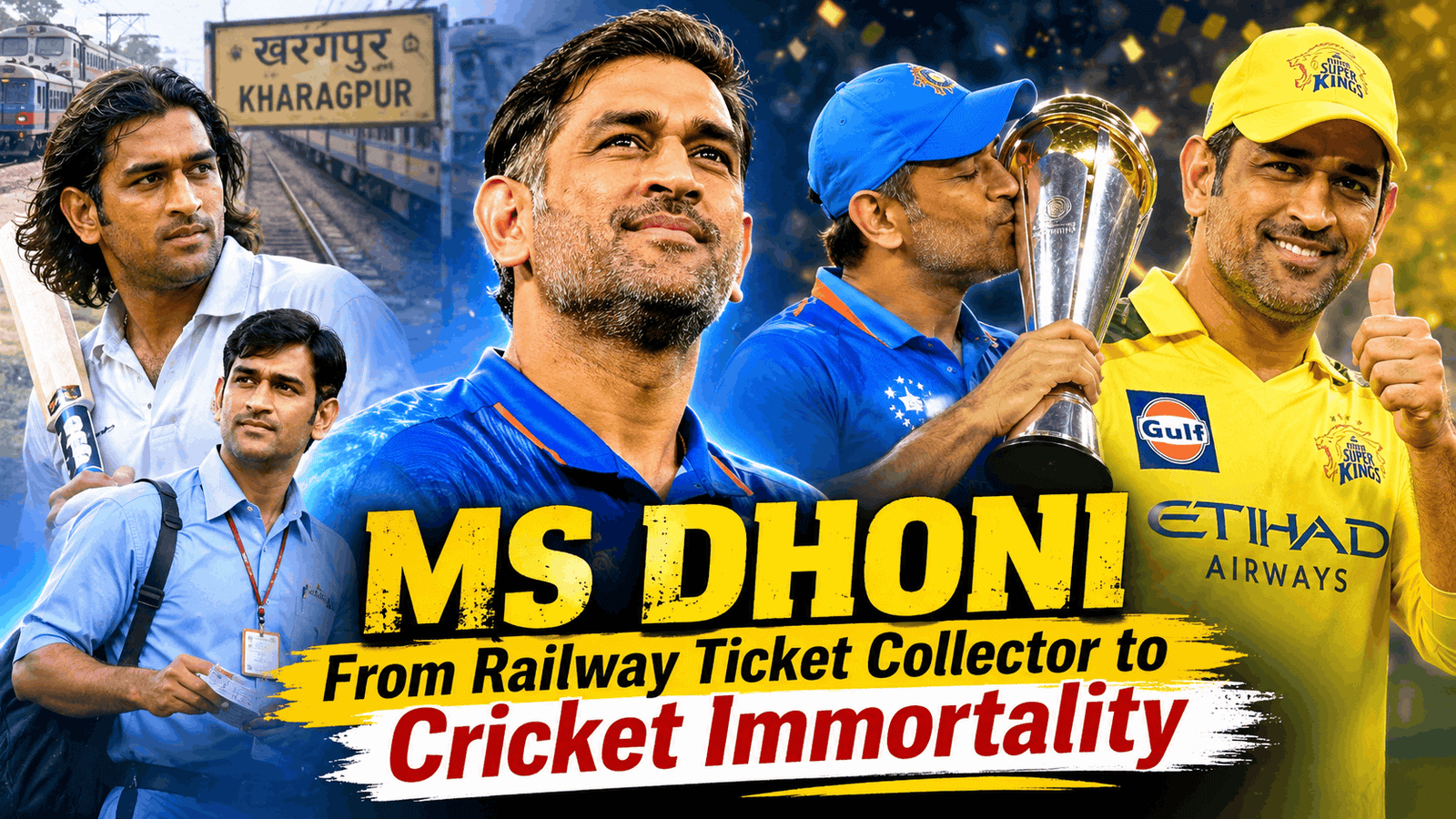
From playing cricket in the streets of Ranchi and representing Bihar in domestic cricket to working as a ticket collector with Indian Railways, Dhoni's journey was built on patience, determination and an extraordinary belief in his abilities.
He eventually became the captain who led India to the ICC T20 World Cup, the ICC Cricket World Cup and the ICC Champions Trophy. He transformed Chennai Super Kings into one of the most successful franchises in IPL history and became a cricketing icon whose influence extends beyond statistics and trophies.
But Dhoni's story is not simply about what he achieved as a player.
It is also about what he built as a leader, how he handled pressure, the players he backed and the legacy he continues to leave behind at Chennai Super Kings.
As discussions around his evolving CSK responsibilities and a possible future association with Indian cricket continue, one question remains interesting: could Indian cricket benefit from MS Dhoni's experience in a mentorship or leadership development role?
To understand that possibility, it is worth revisiting the journey that brought him here.
1. The Ranchi boy who took an unconventional route to cricket
Born on 7 July 1981 in Ranchi, then part of Bihar, Dhoni initially showed an interest in football and badminton. He was a goalkeeper in his school football team before his coach encouraged him to try wicketkeeping.
That decision changed Indian cricket history.
Dhoni attended DAV Jawahar Vidya Mandir in Ranchi and gradually developed into an exciting wicketkeeper-batter. His performances in school and age-group cricket attracted attention, particularly his aggressive batting and ability to hit the ball cleanly.
He represented Bihar at the junior level, including the Vinoo Mankad Trophy Under-16 competition.
However, the journey towards professional cricket was not straightforward. Coming from a smaller cricketing centre, Dhoni did not enjoy the same exposure or opportunities available to players from established cricket associations.
He needed a breakthrough.
2. Ranji Trophy and Indian Railways: The foundation years
Dhoni made his Ranji Trophy debut for Bihar during the 1999–2000 season, aged just 18.
His early domestic career was important because it gave him an opportunity to compete against established players and demonstrate his potential as a wicketkeeper-batter.
In 2001, he joined South Eastern Railway and moved to Kharagpur, West Bengal, where he worked as a Travelling Ticket Examiner (TTE).
For nearly three years, Dhoni balanced his professional responsibilities with his cricketing ambitions.
The railway job provided financial stability, but cricket remained his priority.
His association with Railways also gave him opportunities to continue playing competitive cricket. He represented the Railways team while continuing to pursue higher-level domestic cricket.
The interesting part of Dhoni's story is that he did not abandon his dream despite the uncertainty surrounding his career.
By 2003, his performances had begun attracting attention from talent scouts.
A major breakthrough came through the BCCI's talent identification initiative. Prakash Poddar, a former Bengal cricketer involved in scouting, noticed Dhoni's performances and recommended him for further opportunities.
Dhoni's journey was about to take a dramatic turn.
3. India A selection: The breakthrough that changed everything
Dhoni's selection for the India A tour of Zimbabwe and Kenya in 2004 became a defining moment.
He performed impressively, particularly with the bat, against international-quality opposition.
His aggressive approach, powerful hitting and ability to counterattack made him stand out.
The performances attracted the attention of India's cricket establishment, including then captain Sourav Ganguly and coach Greg Chappell's predecessor John Wright, who was India's coach at the time.
The selectors were looking for a wicketkeeper who could contribute significantly with the bat.
Dhoni offered something different.
He was not just a wicketkeeper who could score useful runs. He had the ability to change the momentum of a match.
His India A performances helped him earn a place in the senior Indian ODI squad for the Bangladesh tour in December 2004.
A clarification about his junior career: Dhoni represented Bihar at junior levels, but his widely documented pathway to the senior Indian team was through domestic cricket and India A. He should not be confused with a player who earned a senior India selection through the India Under-19 World Cup route.
4. Team India selection: An unimpressive beginning, followed by an unforgettable arrival
Dhoni made his ODI debut against Bangladesh on 23 December 2004.
His first international appearance was disappointing. He was run out for a duck.
The following matches also did not immediately produce the results expected of him.
For a young cricketer who had travelled such a long distance to reach international cricket, it could have been a difficult period.
However, India persisted with him.
Then came Pakistan.
On 5 April 2005, in Visakhapatnam, Dhoni was promoted to No. 3 against Pakistan.
What followed was one of the most memorable batting performances by an Indian youngster.
Dhoni smashed 148 runs from just 123 deliveries, featuring 15 fours and four sixes.
It was a statement innings.
India had discovered a wicketkeeper-batter who could attack world-class bowling without being restricted by conventional batting expectations.
Later that year, against Sri Lanka in Jaipur, Dhoni produced another extraordinary performance.
He scored 183 not out from 145 deliveries, with 15 fours and 10 sixes, helping India chase down 299.
That innings remains the highest individual score by a wicketkeeper in men's ODI cricket.
The transformation was complete.
Dhoni was no longer an experimental selection. He was becoming one of India's most important limited-overs players.
5. The early impact: A different kind of Indian cricketer
Dhoni brought a different dimension to Indian cricket.
Until then, Indian wicketkeepers were often selected primarily for their work behind the stumps, with batting contributions considered an additional advantage.
Dhoni changed that expectation.
He could bat in the middle order, accelerate when required, rebuild an innings and finish matches.
His batting was unconventional, but highly effective.
The helicopter shot became his signature. His ability to generate tremendous power without relying on a textbook batting technique made him difficult to contain.
His rise was rapid:
- 2004: Made his ODI debut against Bangladesh.
- 2005: Scored 148 against Pakistan and 183 not out against Sri Lanka.
- 2006: Reached the top of the ICC ODI batting rankings.
- 2007: Became captain of India in the inaugural ICC Men's T20 World Cup.
His international career was beginning to reflect the qualities that would later define his leadership: confidence, adaptability and an ability to handle pressure.
6. Captaincy: From an unexpected choice to India's trophy-winning leader
The 2007 ODI World Cup in the Caribbean was a disappointing experience for India. The team failed to progress beyond the group stage.
Later that year, the BCCI appointed Dhoni captain for the inaugural ICC World Twenty20 in South Africa.
It was a significant decision.
India travelled with a relatively young squad, and Dhoni was given the responsibility of leading the team in a new format.
India defeated Pakistan in a thrilling final to become the inaugural T20 world champions.
Dhoni's captaincy attracted attention because of his calm approach, willingness to trust young players and tactical flexibility.
He subsequently became India's ODI captain and took over the Test captaincy in 2008.
Under his leadership, India achieved success across formats. India's major ICC triumphs under MS Dhoni
2007 – ICC Men's T20 World Cup
India defeated Pakistan in Johannesburg to win the inaugural edition. The tournament established Dhoni as an international captain.
2011 – ICC Cricket World Cup
India defeated Sri Lanka in Mumbai. Dhoni scored an unbeaten 91 and finished the final with the iconic six that secured India's first World Cup title since 1983.
2013 – ICC Champions Trophy
India defeated England in a rain-affected final at Edgbaston. Dhoni became the first and remains the only captain to win all three major ICC men's limited-overs trophies.
His achievements were not restricted to white-ball cricket.
Under Dhoni, India:
- Reached the No. 1 position in the ICC Test rankings in 2009.
- Won the 2008 Commonwealth Bank Series in Australia.
- Won the 2010 Asia Cup.
- Won the 2011 World Cup on home soil.
- Established itself as a major force in international limited-overs cricket.
His leadership style was often described as calm and instinctive. However, behind that calm exterior was an understanding of match situations, player roles and opposition strategies.
India had found a captain who could combine tactical decisions with the confidence to back his players.
7. MS Dhoni's leadership legacy: More than just trophies
One of Dhoni's biggest contributions to Indian cricket was his willingness to back young players.
Several cricketers developed into major international performers during his captaincy.
Some notable examples include:
- Virat Kohli: Dhoni backed Kohli during his early international years and eventually handed him the Test captaincy in 2014.
- Rohit Sharma: Dhoni continued to support Rohit despite inconsistent early performances, including promoting him in the batting order in limited-overs cricket.
- Suresh Raina: Became an important middle-order batter and one of Dhoni's trusted players across formats.
- Ravichandran Ashwin: Developed into a key member of India's bowling attack during Dhoni's leadership.
- Ravindra Jadeja: Became an important all-rounder, particularly in limited-overs cricket.
Dhoni's approach was not about making every player perform according to a fixed template.
He understood that different players required different responsibilities.
His ability to identify roles, provide clarity and back individuals through difficult periods became one of the defining aspects of his captaincy.
There were also difficult decisions and disappointments. India's 2015 World Cup semi-final defeat and the 2019 World Cup semi-final loss against New Zealand were among the painful moments of his international career.
However, his contribution to Indian cricket extended far beyond individual results.
8. The Test retirement and international farewell
Dhoni retired from Test cricket in December 2014 during India's tour of Australia.
The announcement came midway through the series, following the Melbourne Test.
He finished his Test career with:
- 90 Test matches.
- 4,876 runs.
- Six centuries.
- 256 catches and 38 stumpings.
Virat Kohli subsequently took over as India's Test captain.
Dhoni continued playing ODI and T20I cricket, remaining an important part of India's limited-overs plans.
His final international appearance came in the 2019 World Cup semi-final against New Zealand.
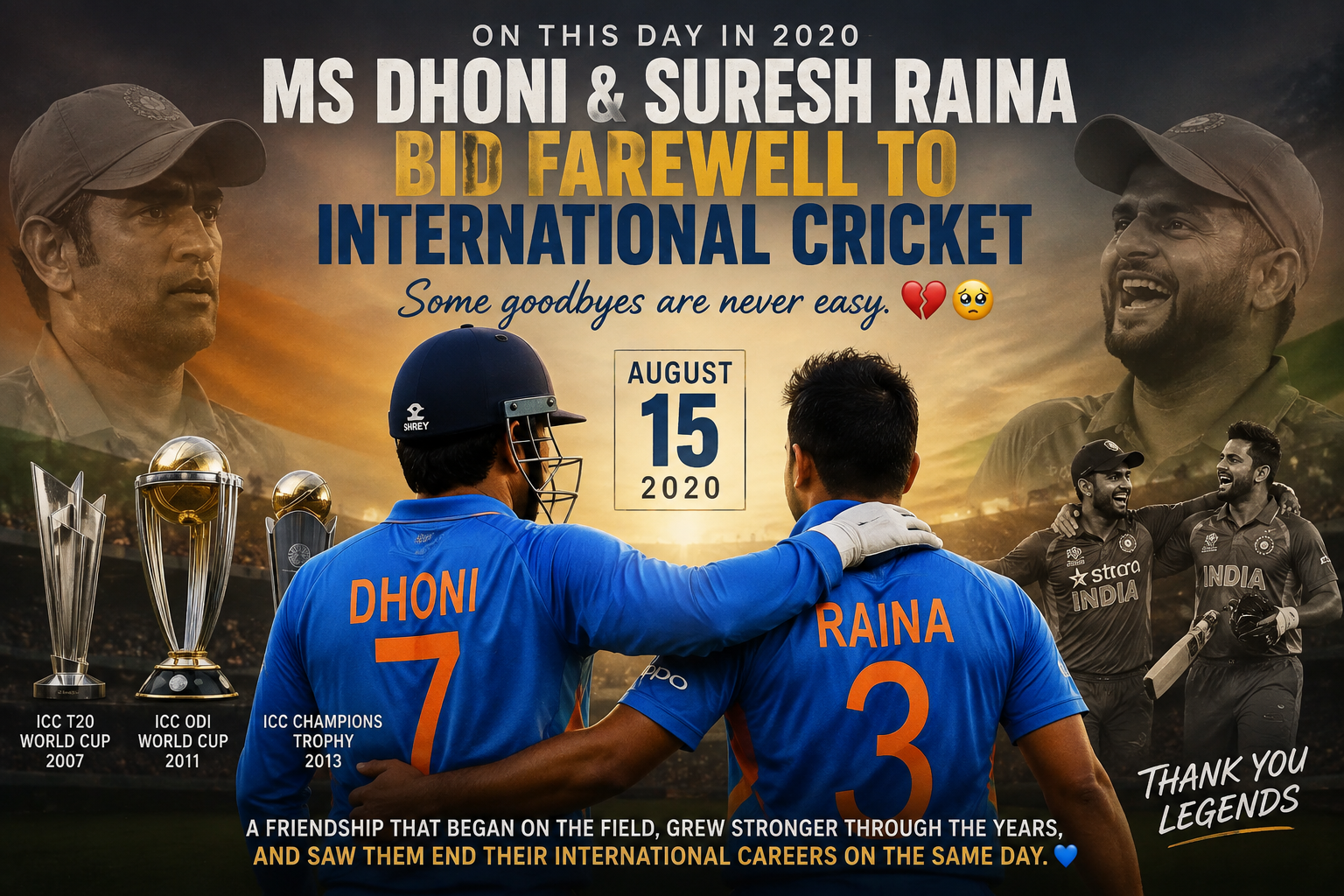
On 15 August 2020, Dhoni announced his retirement from international cricket.
The announcement was characteristically simple.
There was no elaborate press conference or farewell match.
A chapter of Indian cricket had ended.
In 2025, the ICC inducted Dhoni into its Cricket Hall of Fame, recognising his contribution as a wicketkeeper, batter and captain.
9. Chennai Super Kings: A relationship that became an identity
If international cricket established Dhoni as a global superstar, the IPL gave him another platform to build a lasting legacy.
When the IPL began in 2008, Chennai Super Kings made Dhoni one of the most expensive signings in the inaugural auction.
He became the face of CSK.
Under his leadership, Chennai developed a distinct identity: experienced players, clearly defined roles, tactical flexibility and an ability to perform under pressure.
CSK reached the final in its inaugural season and won its first IPL title in 2010.
The franchise successfully defended the title in 2011.
After returning from its two-year suspension, CSK won again in 2018, followed by another championship in 2021.
The fifth title arrived in 2023, when Ravindra Jadeja produced a memorable finish against Gujarat Titans.
MS Dhoni's IPL and Champions League T20 trophy cabinet
| Year | Achievement |
|---|---|
| 2010 | IPL champion – CSK |
| 2010 | Champions League T20 champion – CSK |
| 2011 | IPL champion – CSK |
| 2011 | Champions League T20 runner-up – CSK |
| 2014 | Champions League T20 champion – CSK |
| 2018 | IPL champion – CSK |
| 2021 | IPL champion – CSK |
| 2023 | IPL champion – CSK |
CSK also reached several finals and remained one of the most consistent teams in the tournament during Dhoni's captaincy.
He stepped down as captain before the 2022 season, briefly returning to the position during the campaign. He handed the captaincy to Ravindra Jadeja again ahead of the 2023 season, but subsequently resumed leadership during that tournament.
Ahead of IPL 2024, he passed the captaincy to Ruturaj Gaikwad.
This was another important transition: Dhoni was preparing the franchise for a future beyond his own playing career.
The numbers behind the CSK legacy
By the time he announced his retirement from IPL playing, Dhoni had:
- Led CSK to five IPL championships.
- Won two Champions League T20 titles with CSK.
- Played 272 matches for the franchise.
- Scored 5,314 IPL runs for CSK, according to the franchise figures reported in November 2026.
His relationship with Chennai supporters is difficult to explain through statistics alone.
For many fans, Dhoni is not simply the captain of CSK. He is synonymous with the franchise.
10. The next chapter: MS Dhoni becomes CSK mentor from IPL 2027
For years, speculation surrounding Dhoni's IPL future has been part of every retention season.
Would he play another season? Would he retire? Would he take up a coaching role?
On 17 November 2026, Chennai Super Kings officially confirmed a major change.
MS Dhoni has retired from his IPL playing career and will become the team's mentor from IPL 2027.
The announcement marks the end of an extraordinary playing association that began with the inaugural IPL season in 2008.
Dhoni had missed the entire 2026 IPL campaign with a calf injury. His transition to a non-playing role now gives CSK an opportunity to use his experience in a different capacity.
The franchise is also going through a generational transition.
With Ruturaj Gaikwad leading the side and a number of younger players forming the core, Dhoni's responsibilities could become particularly important.
His new role offers several possibilities:
1. Grooming the next generation
Dhoni can help young players understand the demands of IPL cricket, especially the pressure of playing in front of large crowds and delivering in high-stakes situations.
2. Tactical planning
His understanding of match situations, bowling changes, field placements and opposition strategies can help the coaching group.
3. Building a winning culture
CSK's consistency over the years was built around preparation, clarity and player confidence. Dhoni can help preserve those values.
4. Supporting Ruturaj Gaikwad
His experience could be particularly valuable to Gaikwad as captain, allowing the younger leader to make independent decisions while having an experienced voice in the dressing room.
5. Working alongside Zaheer Khan
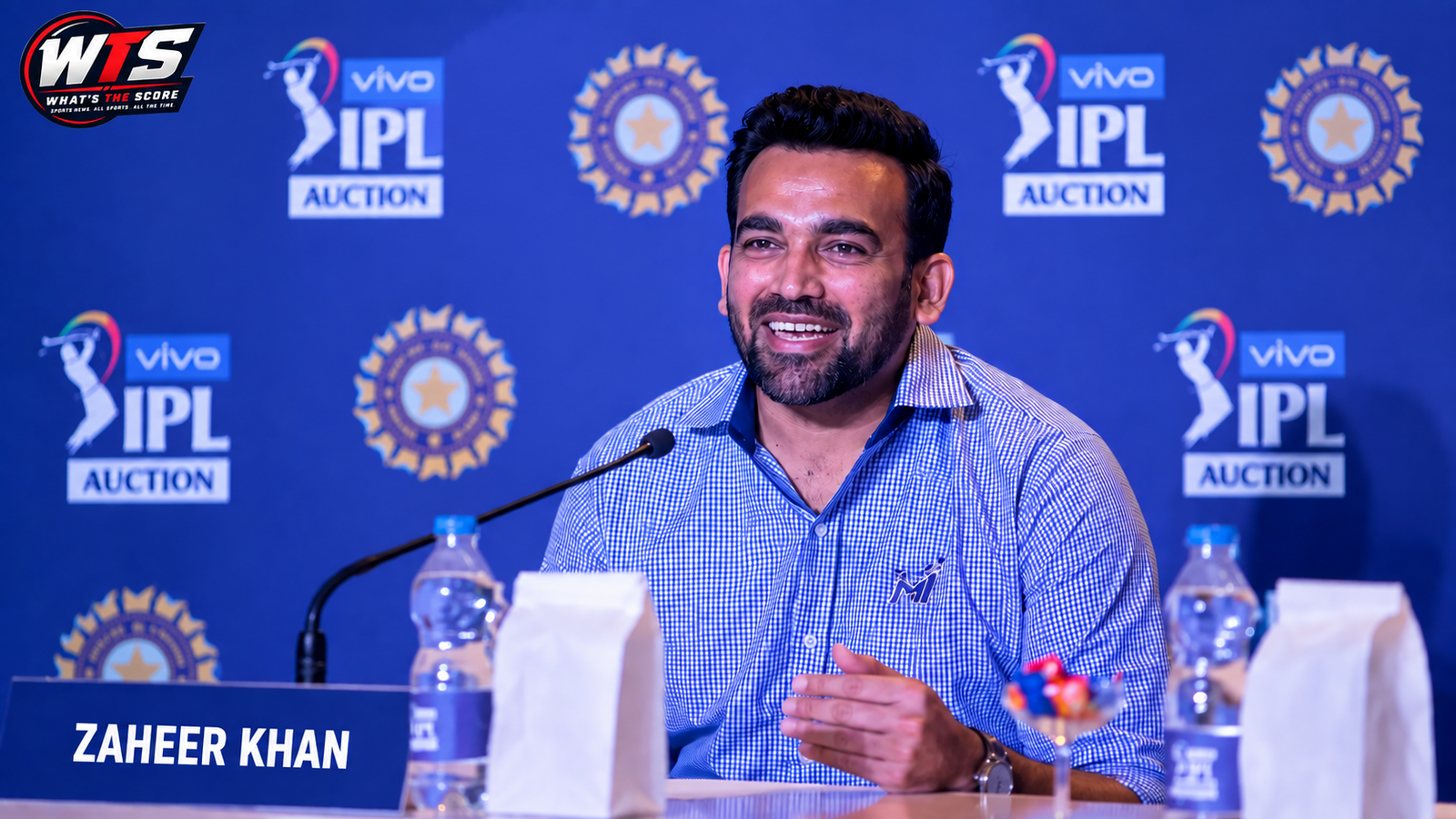
With Zaheer Khan taking the head coach role, the combination of coaching expertise and Dhoni's tactical and leadership experience will be an interesting feature of CSK's new structure.
The biggest challenge will be to ensure that Dhoni's influence helps CSK evolve rather than simply attempting to recreate the past.
After all, the next generation needs its own identity.
11. Could MS Dhoni return to Team India in a mentorship role?
This is perhaps one of the most interesting questions surrounding Dhoni's post-playing career.
India has already benefited from his leadership experience, tactical understanding and ability to manage pressure.
His association with the national team could potentially continue in a non-playing capacity.
There are several areas where his experience could be valuable.
A mentor for India's next generation
Young Indian cricketers entering international cricket often face enormous expectations.
Dhoni understands the transition from domestic cricket to international cricket better than most.
His own journey from Bihar and Railways to the Indian dressing room could offer valuable lessons to players who come from less-established cricketing centres.
A tactical sounding board for India's leadership group
Dhoni's ability to read the game, identify opposition weaknesses and make unconventional decisions remains one of his biggest strengths.
An advisory or mentorship position could allow him to share those insights with India's captaincy group.
Supporting India's wicketkeepers and finishers
Dhoni's experience as a wicketkeeper-batter and middle-order finisher could be particularly useful when developing players for demanding limited-overs roles.
He understands the difference between simply scoring runs and finishing matches.
Should he become India's head coach?
That is a different question.
Dhoni has extensive experience as an international captain and IPL leader, but a coaching appointment involves different responsibilities, including training structures, player management, long-term planning and day-to-day team administration.
There is no confirmed announcement of Dhoni taking up a Team India coaching or mentorship position.
The BCCI would also need to define the position and its responsibilities.
A future association is possible, but it should not be presented as an established plan.
In the immediate future, his confirmed responsibility is with Chennai Super Kings.
12. What makes MS Dhoni different? The leadership lessons
Dhoni's career offers several lessons that go beyond cricket.
Trust over reputation: He often backed players based on their roles and potential rather than their reputation.
Composure under pressure: His ability to remain calm in difficult situations became one of his most recognisable characteristics.
Adaptability: He succeeded in Test, ODI, T20I and IPL cricket by adjusting his approach to different situations.
Team before individual records: Dhoni was rarely concerned about personal milestones when a team objective was at stake.
Planning for succession: His decision to hand over the CSK captaincy to Ruturaj Gaikwad showed that he understood the importance of preparing the franchise for its future.
His career also reminds aspiring cricketers that the route to the top need not be conventional.
A young boy from Ranchi, who once worked as a railway ticket examiner in Kharagpur, eventually became one of the most influential figures in world cricket.
13. The legacy of MS Dhoni: The journey continues
MS Dhoni's journey has come full circle in an unusual way.
He started as a young cricketer trying to establish himself in domestic cricket. He fought for opportunities, worked a regular job and waited for his moment.
When that opportunity arrived, he made sure the cricketing world noticed.
He became India's World Cup-winning captain, transformed the expectations from wicketkeeper-batters, built a successful IPL franchise and inspired a generation of cricketers.
Now, as he moves into the CSK mentorship role, his contribution will increasingly be measured not by runs, dismissals or trophies, but by the players he helps develop and the decisions he influences.
Perhaps the most interesting chapter of his cricketing journey is still ahead.
He may no longer walk out to bat wearing India's blue or CSK's yellow, but his influence on the game is unlikely to disappear.
From a railway ticket collector in Kharagpur to a World Cup-winning captain and now a mentor at Chennai Super Kings – MS Dhoni's story is a reminder that extraordinary journeys often begin in ordinary places.