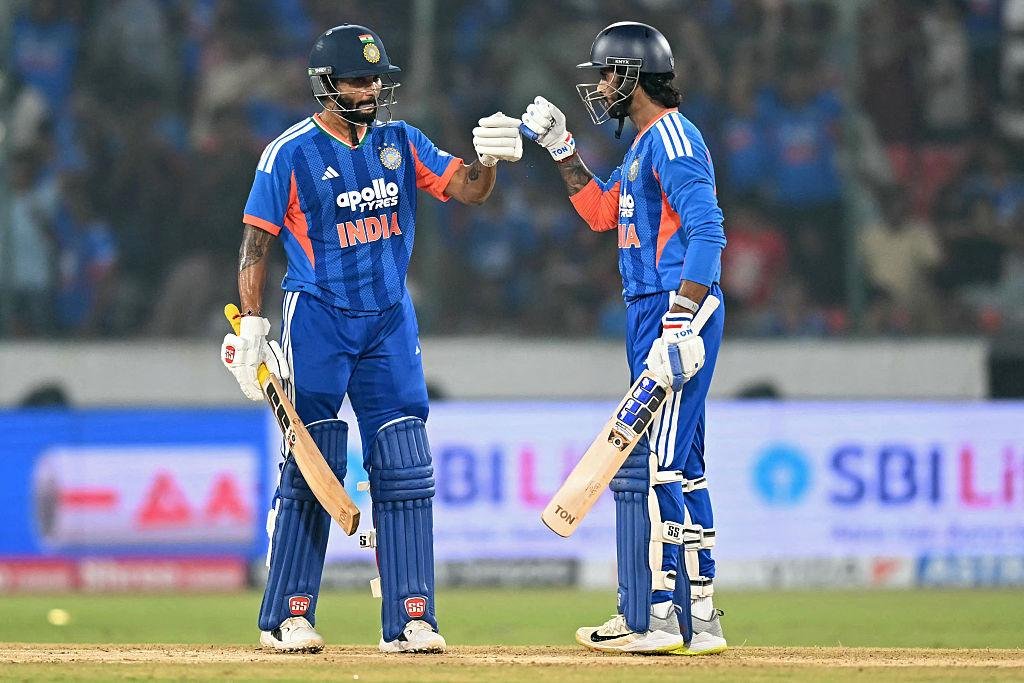
India's winning streak against New Zealand came to an end in Auckland. Glenn Phillips and Michael Bracewell dismantled the Indian bowling attack before Jacob Duffy delivered a devastating opening-over blow. With the series already secured, India have some serious questions to answer before the final T20I.
India had won the first three matches, secured the series and appeared to be in complete control of the New Zealand tour. But cricket has a habit of reminding teams that yesterday's dominance guarantees nothing tomorrow.
The fourth T20I at Eden Park, Auckland, was exactly that reminder.
New Zealand registered a comprehensive 87-run victory after putting up a massive 259/7 in 20 overs. India, chasing 260, could only manage 172/9.
Glenn Phillips was the headline act with a breathtaking 107 off 49 balls, while Michael Bracewell added 65 off just 25 deliveries. For India, it was a night when the bowling lacked discipline, the fielding missed crucial opportunities and the batting never recovered from a disastrous start.
The series remains 3-1 in India's favour, but the manner of this defeat deserves attention.
Let's break down where India went wrong, what New Zealand did brilliantly and how India can bounce back.
1. Glenn Phillips and Michael Bracewell: The partnership that changed everything
New Zealand did not have the perfect beginning.
Tim Seifert and Daryl Mitchell departed during the powerplay, and India had an opportunity to restrict the hosts to a manageable total.
But Glenn Phillips had other plans.
Phillips played an extraordinary innings, scoring 107 from 49 deliveries, including six fours and ten sixes. He attacked both pace and spin and refused to allow Indian bowlers to settle into a rhythm.
The real damage, however, came when Michael Bracewell joined him.
Bracewell scored 65 from just 25 balls, reaching his half-century in only 19 deliveries. Their 115-run partnership from 41 balls completely transformed the game.
One particular over exposed India's problems. Nitish Kumar Reddy was taken apart by Phillips, who smashed four consecutive sixes in the 16th over.
Suddenly, a competitive total became an enormous one.
New Zealand finished on 259/7, their highest T20I total, and the first time they had crossed 250 in a T20 International on home soil.
India had no answer to the Phillips-Bracewell assault.
2. India's biggest mistake: Poor execution with the ball
Winning the toss and electing to bowl was not necessarily the wrong decision. India had successfully chased targets in the first three matches and backed their batting strength.
The problem was what followed.
India's bowling attack struggled to maintain consistent lines and lengths once Phillips and Bracewell started attacking.
Nitish Kumar Reddy endured a particularly difficult outing, conceding 64 runs in his four overs. Axar Patel went for 43 in three overs, while Prince Yadav conceded 49.
Even experienced campaigner Arshdeep Singh could not provide the control India needed.
There were three major issues:
Lack of variation: Indian bowlers allowed the batters to settle into their preferred hitting zones. Against power-hitters like Phillips and Bracewell, predictable lengths can be extremely expensive.
Inconsistent execution: Too many deliveries landed in areas where the New Zealand batters could free their arms. At Eden Park, where the ground dimensions can reward clean hitting, that is a dangerous combination.
Failure to respond under pressure: Once Phillips started accelerating, India needed a change of plans. Wider lines, variations in pace, changes in angles and smarter field placements could have helped disrupt his rhythm.
India's bowling figures tell the story. They conceded nearly 13 runs per over.
That is simply not good enough at international level.
3. The missed opportunity: Glenn Phillips gets a lifeline
There was another moment India will look back at with regret.
Glenn Phillips was given a reprieve when Naman Dhir misjudged a difficult, high catch off Axar Patel's bowling.
Catching opportunities against a batter of Phillips' calibre are precious. Once he survived, he made India pay.
It is unfair to suggest that one missed chance alone decided the match. Phillips still had to produce the innings, and he did so brilliantly.
But the incident highlights an important lesson: against an opponent capable of scoring at a strike rate above 200, even one missed opportunity can become costly.
India's fielding standards have generally been a strength. They will want to ensure this performance remains an exception.
4. Jacob Duffy delivers the knockout punch
If New Zealand's batting had put India under pressure, their bowling ensured there would be no comeback.
India needed an explosive start in pursuit of 260.
Instead, they lost Sanju Samson and Ishan Kishan in the opening over.
Jacob Duffy removed both openers and finished with outstanding figures of 4/23 in four overs.
It was a dream start for New Zealand and a nightmare for India.
Abhishek Sharma tried to counterattack, scoring 27 from 15 balls, while Shreyas Iyer made 22 from 11 deliveries. But both fell before the powerplay ended.
India were reduced to 56/4 inside 5.3 overs.
At that point, the chase was practically over.
The problem was not simply losing wickets. It was losing too many wickets before establishing any meaningful partnership.
When chasing 260, a team needs to maintain a balance between aggression and survival. India had aggression, but very little stability.
5. India's middle order failed to provide resistance
There were contributions from Nitish Kumar Reddy, Naman Dhir and Tilak Varma, but none could build an innings capable of putting New Zealand under pressure.
Nitish scored 21 from 10 balls, while Naman Dhir contributed 28 from 13 deliveries.
Tilak Varma top-scored with 35, but his innings came off 35 balls.
Tilak deserves credit for staying at the crease and trying to rebuild. However, the situation demanded a much faster scoring rate.
India had lost six wickets by 89 runs, and the required run rate had climbed beyond a realistic recovery.
This is where India's batting approach needs some reflection.
There is a difference between playing aggressively and playing intelligently.
A massive chase requires partnerships, calculated risks and an understanding of when to attack particular bowlers.
India lost wickets at regular intervals and never found the partnership that could have given the chase some life.
6. Where New Zealand got it right
New Zealand deserve enormous credit. This was not merely a case of India playing badly. The hosts executed their plans exceptionally well.
Glenn Phillips took responsibility: He understood the situation after early wickets and played the anchor-aggressor role perfectly. His acceleration was remarkable.
Michael Bracewell changed the tempo: His 19-ball fifty meant India could not concentrate their plans around Phillips alone. The pressure was coming from both ends.
Jacob Duffy attacked the stumps: Removing both openers in the first over was precisely what New Zealand needed. Duffy never allowed India to settle.
Mitchell Santner controlled the middle overs: His 2/24 was crucial. He dismissed Axar Patel and Nitish Reddy in the same over, effectively ending India's hopes of a recovery.
New Zealand understood the conditions: Eden Park rewards power-hitting, but it also demands smart bowling and good execution. New Zealand used their opportunities better in both innings.
This was a complete team performance from the Black Caps.
7. How can India make a comeback in the fifth T20I?
The good news for India is that one defeat has not changed the series result. They have already secured a 3-1 lead.
However, the fifth T20I in Hamilton on November 1 offers an opportunity to finish the tour on a winning note.
Here are five areas India should address.
A. Reassess the bowling combinations
India need to examine their bowling balance.
Nitish Reddy's all-round ability is valuable, but his expensive outing highlights the importance of having enough reliable bowling options.
The team management should consider whether an additional specialist bowler would provide better control.
India also need to use their frontline bowlers more strategically rather than allowing a partnership to dictate the innings.
B. Improve fielding and catching standards
The Phillips reprieve was an important moment.
India must take their opportunities, particularly against batters who can change a match within a few overs.
Catching, boundary protection and communication need to be sharper.
C. Give the top order a clear plan
The opening combination needs to find the right balance.
India should not abandon their attacking philosophy, but they must recognise that losing two wickets in the opening over makes even a strong batting line-up vulnerable.
A little more awareness of the situation can make a significant difference.
D. Build partnerships in the middle overs
The middle order needs to understand that not every situation requires an immediate boundary.
Tilak Varma, Naman Dhir and Nitish Reddy have the ability to contribute valuable runs. The challenge is to build partnerships while maintaining a healthy scoring rate.
E. Finish the series with intent
India should not allow this defeat to create unnecessary doubt.
The first three matches demonstrated their batting depth and ability to chase challenging targets.
The response in Hamilton should be about better execution, not a complete overhaul of their approach.
8. Final verdict: A defeat India needed to learn from?
There is no reason for India to panic.
They have already won the series, and one heavy defeat should not erase the confidence built over the first three matches.
But there are lessons here.
The bowling attack needs better execution against aggressive middle-order batters. The fielders must convert opportunities. The batting unit needs to demonstrate that it can handle pressure when the top order fails.
For New Zealand, this victory will provide enormous confidence. After losing the opening three matches, the Black Caps finally showed what they are capable of when their batting and bowling click together.
For India, Hamilton is an opportunity to respond.
A series win is already secured. Now the challenge is to finish strongly.
Because champions are not defined only by how they win. They are also defined by how they respond after a defeat.