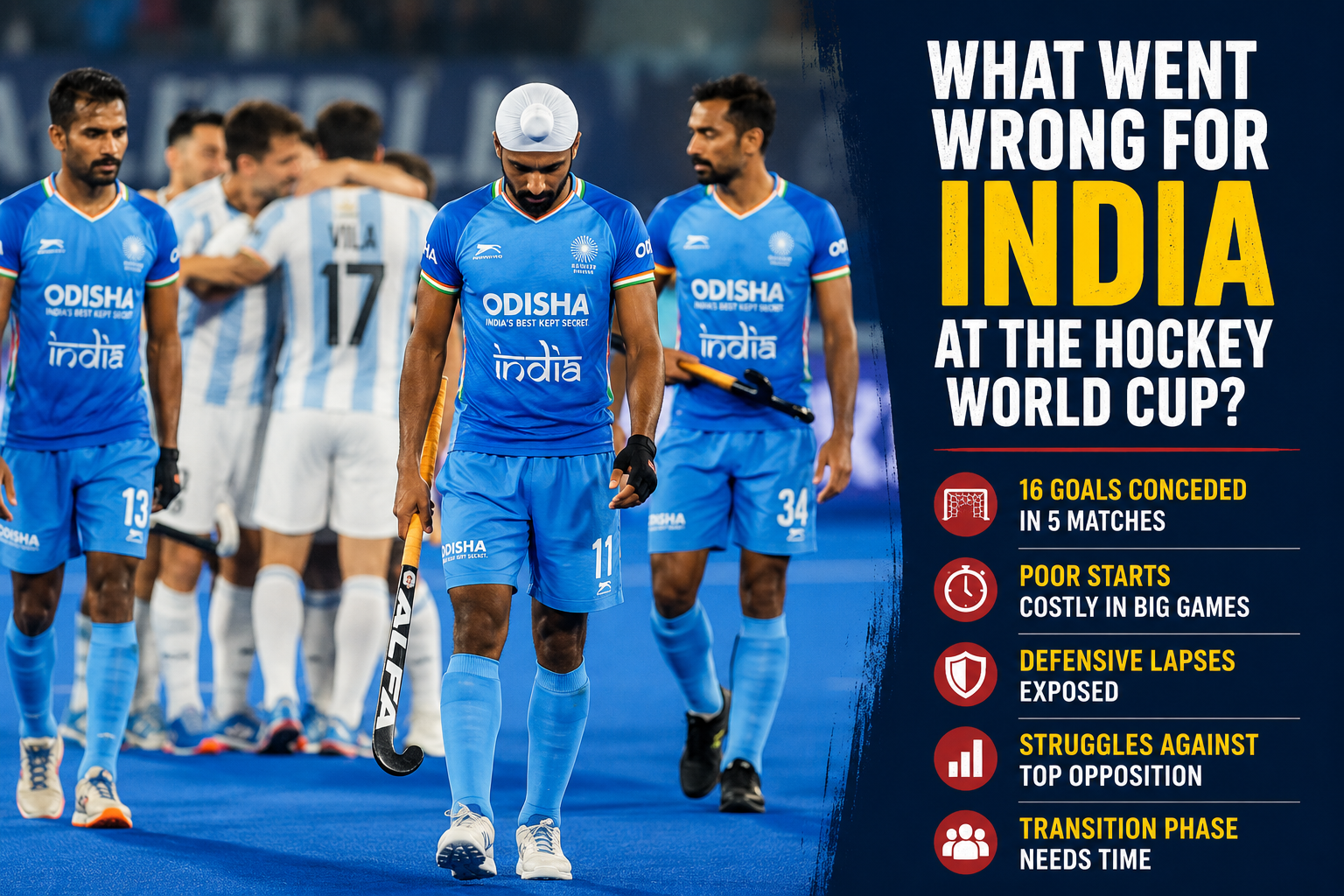
India’s campaign at the 2026 FIH Men’s Hockey World Cup ended in disappointment, with a 5-3 defeat to Argentina ending their hopes of reaching the semi-finals. The result exposed weaknesses that had been visible throughout the tournament — most notably defensive lapses, poor starts and India’s difficulty in beating higher-ranked opponents.
For a team that had won back-to-back Olympic bronze medals in Tokyo and Paris, the World Cup exit represents more than just another disappointing tournament. It raises questions about India’s ability to consistently compete with the world’s best and whether the current squad is equipped for the next Olympic cycle.
A World Cup Exit That Exposed Deeper Problems
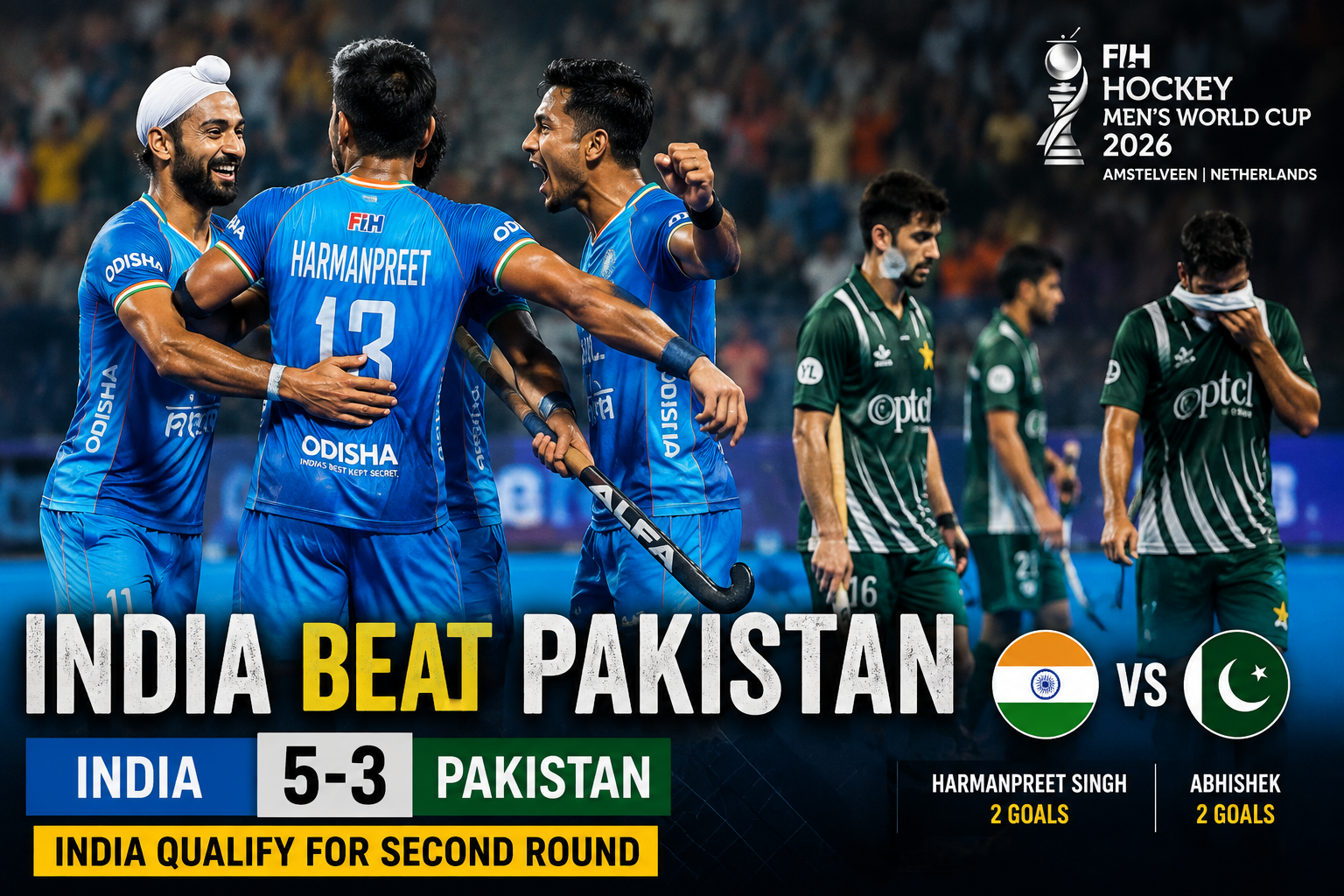
India entered their final Pool E game against Argentina knowing that only a victory by at least two goals would keep their semi-final hopes alive. Instead, Argentina took control early and eventually won 5-3.
The defeat followed India’s 3-1 loss to the Netherlands and meant the team could not secure a place in the last four.
The worrying part was not simply the result. India had struggled to produce their best hockey when facing the strongest opponents in the tournament.
They lost to England, the Netherlands and Argentina — all higher-ranked teams — each time by a two-goal margin. That pattern points towards a significant performance gap when India faces elite opposition.
Defensive Fragility Became India’s Biggest Weakness
The numbers tell a concerning story.
India conceded 16 goals in five matches, their worst defensive record at a World Cup since 2010. Even more worrying, 12 of those goals came from open play, suggesting that the problem was not restricted to penalty-corner defence.
Against Argentina, India conceded twice inside the opening six minutes. The first goal arrived after an unmarked player was allowed to finish a cross, while the second followed hesitation between Indian defenders and resulted in a penalty corner.
Once Argentina established that early advantage, India were forced to chase the game.
Head coach Craig Fulton acknowledged that India started poorly and made defensive mistakes, while Sukhjeet Singh also admitted that the team committed errors at the back.
The Attack Also Failed to Provide Enough Solutions
India scored 14 goals in the tournament, but only five came from field goals. That statistic highlights another concern: the team struggled to consistently create and convert attacking opportunities from open play.
Sukhjeet Singh's two goals against Argentina demonstrated India's ability to fight back, while Hardik Singh also converted a penalty stroke. But by then, Argentina had created too large a cushion.
India's attacking problems became particularly visible when the team needed to dictate games rather than react to them.
The World Cup Problems Did Not Start in Amstelveen
The disappointing World Cup campaign was not an isolated failure.
India finished eighth in the FIH Pro League, winning only four of their 16 matches. Their broader 2026 record also showed considerable inconsistency, with 10 defeats in 21 matches and 45 goals conceded.
That form should have served as a warning before the World Cup.
Instead, the same issues — defensive uncertainty, inconsistent performances and difficulties against top-ranked teams — resurfaced on the biggest stage.
The Generational Transition Is Another Challenge
India are also dealing with the consequences of a changing squad.
The absence of experienced defenders such as Rupinder Pal Singh and Birender Lakra, combined with the retirement of legendary goalkeeper P. R. Sreejesh, has left significant experience to replace.
The challenge now is finding the right balance between experienced players and younger talent.
A successful transition cannot simply mean replacing older players one by one. India need to build a deeper pool of players who have enough international exposure to handle high-pressure matches against the Netherlands, England, Germany, Belgium and Argentina.
India Still Have a Chance to Reset
Despite the disappointment, the World Cup exit can become a turning point.
Former India captain Viren Rasquinha has called for serious introspection, particularly in areas such as fitness, selection, tactics and squad depth. He also warned that a strong result at the Asian Games should not be allowed to hide the structural problems exposed by the World Cup.
The Asian Games are particularly important because they are linked to qualification for the Los Angeles 2028 Olympics. India therefore have little time to dwell on the World Cup disappointment.
The immediate priority should be clear: strengthen the defence, develop younger players, improve consistency against top-ranked teams and create greater competition for places.
What Went Wrong for India at the Hockey World Cup?
India's World Cup failure can be traced to several interconnected problems:
- Poor defensive organisation: 16 goals conceded in five matches exposed serious vulnerabilities.
- Slow starts: India repeatedly found themselves under pressure before establishing control.
- Difficulty against elite teams: Losses to England, the Netherlands and Argentina highlighted the gap at the top level.
- Limited attacking efficiency: Only five of India's 14 goals came from field play.
- Squad transition: India are still adjusting to the loss of experienced players from previous Olympic campaigns.
- Inconsistent preparation results: The eighth-place Pro League finish had already indicated weaknesses.
The Bigger Question for Indian Hockey
India's Olympic resurgence had created optimism around the men's team. Back-to-back bronze medals suggested that the country was once again becoming a consistent force in international hockey.
The World Cup, however, has exposed the difference between being competitive and being capable of challenging for the biggest titles.
India's next challenge is not simply to win the Asian Games. It is to build a team capable of beating the world's best when the pressure is highest.
The 51-year wait for another men's Hockey World Cup podium finish continues. The way India responds to this disappointment will determine whether the World Cup exit becomes a setback — or the starting point for a much-needed rebuild.