India's cricket selection enters a new chapter as Pragyan Ojha becomes chief selector and Ramesh Powar joins the panel. With the 2027 ODI World Cup approaching, the biggest challenge will be balancing proven match-winners with the next generation of Indian cricket.
Indian cricket has a new selection committee, and the timing could hardly be more significant.
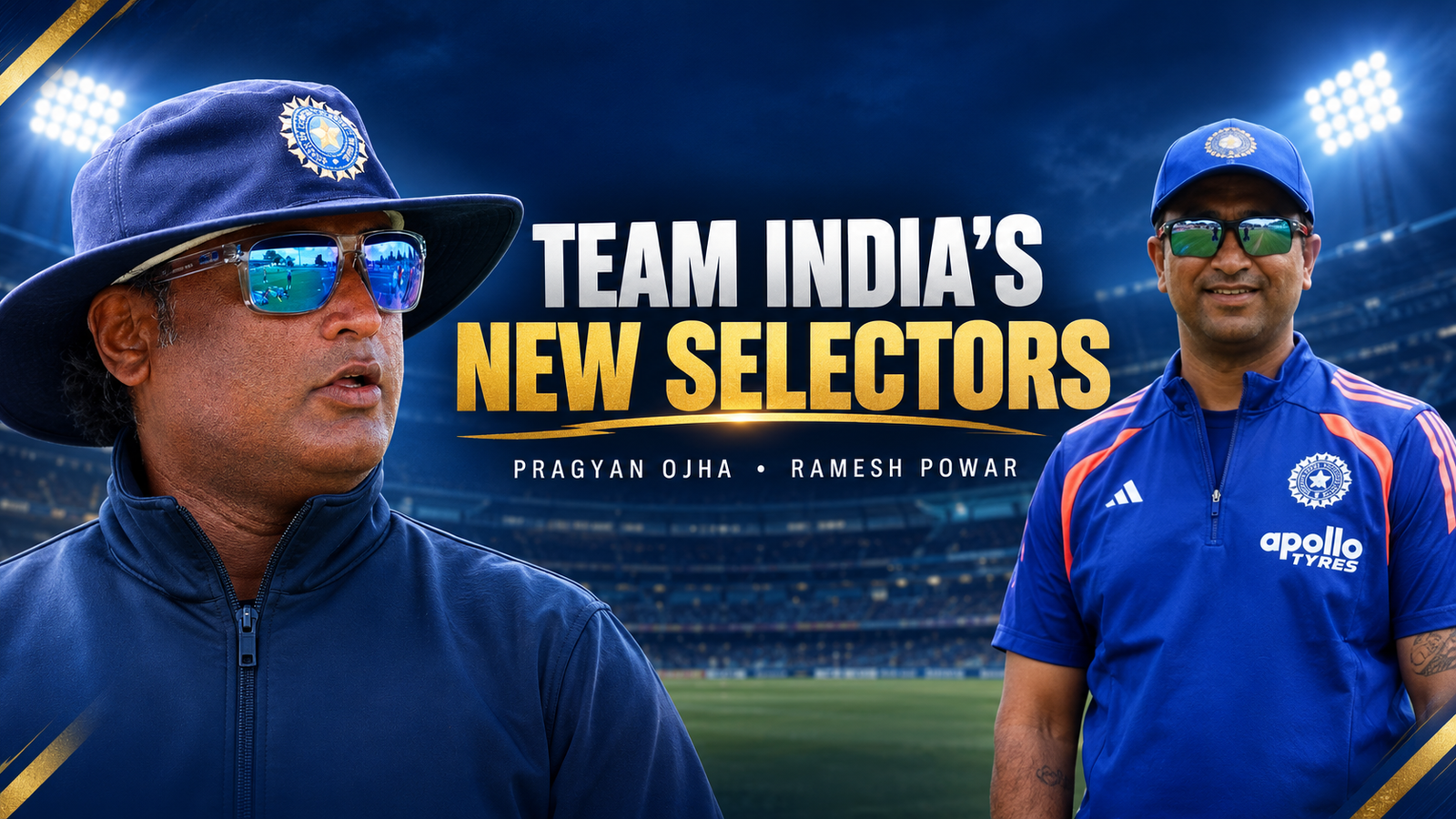
The Board of Control for Cricket in India (BCCI) has appointed former India spinner Pragyan Ojha as chairperson of the men's senior selection committee, while former India off-spinner Ramesh Powar has joined the five-member panel. The appointments were confirmed on October 19, 2026, following a selection process conducted by the Cricket Advisory Committee (CAC).
Ajit Agarkar's tenure has come to an end, bringing a change in leadership after a successful period for Indian cricket. Now, the spotlight shifts to Ojha and his colleagues, who must make some crucial decisions about squad composition, player development and India's long-term plans across formats.
But who are the new selectors, what does their experience bring to the table, and what should Indian cricket fans expect from this new committee?
Who Are the Members of India's New Selection Committee?
The reconstituted men's senior selection committee consists of five members, combining international playing experience with coaching and cricket-development backgrounds.
Selector Role Pragyan Ojha Chairperson Shiv Sundar Das Member RP Singh Member Ajay Ratra Member Ramesh Powar MemberOjha takes over the chairperson's role based on seniority, determined by the number of Test matches played by members of the committee. He had already been serving as interim chairman following Agarkar's departure.
The committee will now be responsible for selecting India's men's squads across formats, making its decisions particularly important as the team prepares for major international assignments.
Pragyan Ojha: A New Voice at the Top
Pragyan Ojha is no stranger to international cricket. The former left-arm spinner represented India in 24 Tests, 18 ODIs and six T20Is, taking 113 wickets in Test cricket.
His appointment brings a selector with substantial red-ball experience into the chairperson's role. Ojha was also part of India's international cricket environment during a period when spin bowling played a significant role in the team's success at home and abroad.
However, playing experience alone will not define his tenure.
The real test will be how Ojha evaluates players across different conditions, identifies the right combinations and manages the transition between established stars and emerging talent.
India's selection committee must look beyond individual statistics. A player who dominates domestic cricket may need time to adapt internationally, while an experienced international player might still have an important role in a specific format.
Ojha's challenge will be to maintain consistency in selection while remaining flexible enough to respond to changing team requirements.
Ramesh Powar Joins the Panel: Experience Beyond Playing
Ramesh Powar's appointment is another important development.
Powar represented India in two Tests and 31 ODIs during his international playing career. After retirement, he built considerable experience as a coach, including stints as head coach of the Indian women's team, Mumbai and Gujarat, alongside a bowling-coach role at the BCCI Centre of Excellence.
His coaching background could be particularly valuable when assessing bowling combinations, player development and tactical suitability.
Powar also guided India's women's team to an Asia Cup title and a silver medal at the Commonwealth Games during his tenure. Those experiences exposed him to the demands of managing international players, preparing teams for major competitions and making tactical adjustments under pressure.
Selection, of course, is different from coaching. A selector must identify the right players before they enter the team environment, rather than simply work with the players already available.
That distinction will matter as Powar settles into his new role.
His experience across men's and women's cricket, as well as domestic coaching, could provide the panel with another perspective when evaluating players and squad balance.
Ajit Agarkar Leaves Behind a Successful Legacy
Any discussion of the new selection committee must acknowledge the achievements of the outgoing chairman, Ajit Agarkar.
Appointed in July 2023, Agarkar led the men's selection committee through a highly successful period. The BCCI credited his panel with overseeing three ICC trophies, two Asia Cup titles and consecutive Asian Games gold medals during his tenure.
India's major ICC successes during this period included the 2024 and 2026 Men's T20 World Cups and the 2025 Champions Trophy. The team also reached the final of the 2023 ODI World Cup.
Agarkar's departure follows the end of his tenure, with reports indicating that he did not seek an extension. The BCCI formally acknowledged his contribution and thanked him for his commitment to Indian cricket.
Replacing a chairman who leaves behind such a successful record is never straightforward.
Ojha will inherit a team with high expectations, a strong talent pool and a fan base that increasingly expects India to compete for every major trophy. The new committee must preserve that winning culture while ensuring that the team remains prepared for the future.
What Are the Biggest Challenges for the New Selection Committee?
1. Building a squad for the 2027 ODI World Cup
The 2027 ODI World Cup in South Africa will be one of the biggest challenges on India's horizon.
Conditions in South Africa can demand a different approach from the one used in India. Pace, bounce, seam movement and the ability to build partnerships under pressure can influence team combinations.
The selectors will need to identify players suited to those conditions and give them meaningful opportunities well before the tournament.
Waiting until the final stages to settle on a first-choice combination could leave India short of preparation time. The committee must use bilateral series and other international assignments to test options and build a reliable core.
2. Managing the transition between experienced players and young talent
India has no shortage of emerging cricketers, but finding the right time to introduce them remains a major selection challenge.
Established players bring experience, temperament and an understanding of pressure. Younger players bring energy, fresh skills and the potential to serve Indian cricket for years.
The new committee must find the right balance rather than treating experience and youth as opposing choices.
Domestic cricket, India A tours and performances across formats should all contribute to selection decisions. Reputation matters, but current form, fitness, role suitability and consistency must carry significant weight.
3. Selecting across three different formats
India's Test, ODI and T20I teams have different tactical requirements.
Test cricket demands patience, technical discipline and the ability to perform over extended periods. ODI cricket requires flexibility, with players capable of adapting to different phases of an innings. T20 cricket places a premium on specialist skills, rapid decision-making and impact.
The selectors must recognise these differences rather than assume that success in one format guarantees success in another.
Clear communication about player roles will also be important. Players should understand what is expected of them and what they need to demonstrate to earn or retain their places.
4. Building a stronger talent pipeline
A successful senior team needs a reliable system feeding talent into international cricket.
That means monitoring domestic competitions, rewarding sustained performances and ensuring that promising players receive opportunities at the appropriate level.
Powar's coaching background and the wider experience of the selection panel could help bring different perspectives to talent identification.
The key will be consistency. One outstanding innings or a short burst of wickets should not automatically outweigh a longer record of performances, although exceptional talent must not be overlooked simply because it is relatively inexperienced.
Can the New Committee Maintain India's Winning Momentum?
The new panel begins with an advantage: India already has a deep pool of international and domestic talent.
But the challenge is not simply to select eleven talented players. It is to assemble a team in which every player has a clear role and the combination works under different conditions.
The selectors will also have to make difficult calls. There will be questions about workload management, injuries, form, succession planning and the balance between specialists and all-rounders.
Not every decision will satisfy fans, and selection debates are an unavoidable part of Indian cricket. What matters is whether the committee can make consistent, well-reasoned decisions that support the team's long-term objectives.
Ojha's leadership and Powar's coaching experience provide an interesting combination. Their success, however, will ultimately be judged by the quality of India's squads, the development of future international players and the team's performances in major tournaments.
The Verdict: A New Committee, a Familiar Expectation
Indian cricket has changed its selection leadership, but the expectation remains the same: compete for trophies and keep producing players capable of performing at the highest level.
Pragyan Ojha now leads a panel that includes Shiv Sundar Das, RP Singh, Ajay Ratra and Ramesh Powar. The group inherits the achievements of the Agarkar era and the responsibility of preparing India for its next set of challenges.
The immediate focus will be on selecting balanced squads and building towards the 2027 ODI World Cup. Beyond that, the committee must ensure that India's success does not depend solely on its current generation of stars.
For Indian cricket fans, the biggest question is straightforward: can this new selection committee maintain the winning momentum while building the next generation of match-winners?
The answers will emerge through its selections, its willingness to make difficult calls and, ultimately, the performances of Team India on the field.