From the cricket grounds of Delhi to conversations about Rishabh Pant’s comeback and Tiger Woods’ biomechanics, Rishika Abrol is proving that you don’t have to wait until you are older to make a difference in sport.
What happens when an athlete gets injured? What does it take to return to the highest level? And what goes on inside the body and mind when the world sees only a comeback story?
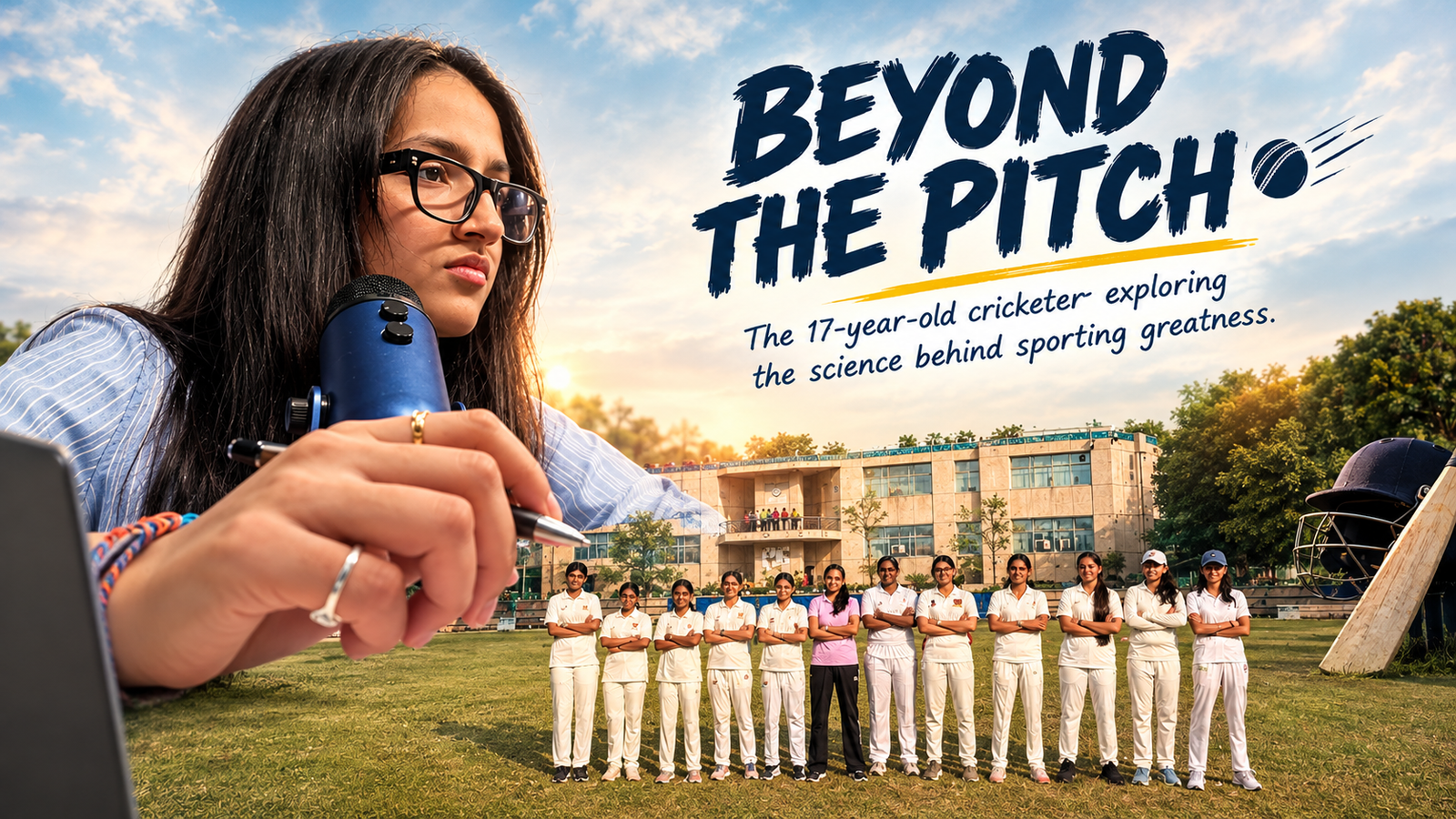
For 17-year-old Rishika Abrol, these questions are more than topics for discussion. They are questions born out of her own experience as a cricketer — and the starting point of Beyond the Pitch, a sports-science podcast she founded to explore the science and human stories behind elite athletic performance.
A student, cricketer, podcast host and school sports captain, Rishika is balancing several roles at an age when most people are still figuring out which direction they want to take. But her interests are connected by one common thread: a desire to understand sport beyond what appears on the scoreboard.
Her journey is also about something bigger than a podcast. It is about turning a difficult phase in her own sporting life into an opportunity to learn, building a platform through conversations with experts, and creating a space for girls to play cricket at a school that had never fielded a women's team.
When an injury became the beginning of an idea
Rishika has spent four years training at The Future Cricket Academy and has also trained at the Delhi Capitals Cricket Academy for the past year. Cricket has been a constant in her life, offering a place to channel her energy, focus and emotions.
But an enforced break from the game changed the way she looked at the sport.
“I remember when I had to take a break from cricket, I felt hollow, as if a part of me went missing,” she recalls.
For an athlete, an injury or a forced absence can mean more than missing matches and training sessions. It can disrupt routines, affect confidence and leave a difficult question hanging in the air: when will I be able to return?
For Rishika, the experience sparked a different kind of curiosity. As someone who enjoys science as much as sport, she wanted to understand what was happening when an athlete got injured. What changes inside the body? How does rehabilitation work? What role do psychology and nutrition play in recovery? And why do some comebacks demand so much more than physical healing?
She was studying Physics, Chemistry and Mathematics (PCM), while continuing to pursue cricket. Instead of treating the two interests as separate worlds, she decided to bring them together.
That is how Beyond the Pitch began.
The idea was simple but ambitious: look beyond the result and explore the science, setbacks, decisions and human experiences that shape an athlete's journey.
Beyond the highlights: Understanding the cost of a comeback
Sports coverage often celebrates the moment an athlete returns. The comeback match, the winning shot, the standing ovation and the emotional celebration become the defining images of the story.
But the road to that moment is rarely as straightforward.
Beyond the Pitch explores the biochemical and physiological aspects of sporting performance, alongside biomechanics, psychology, nutrition, injuries and rehabilitation. Its broader purpose is to understand not just what happened to an athlete, but what the experience cost, what changed and what it reveals about resilience.
To bring the idea to life, Rishika began reaching out to doctors and experts through LinkedIn, building professional connections and developing the research and communication skills needed to host informed conversations.
It was a learning process that extended well beyond cricket and science. She had to take on research, scripting, interviewing, editing, branding, content creation and audience building — all while managing school and sporting commitments.
The result is a platform that reflects her own interests: science, sport and storytelling.
Since its launch, Beyond the Pitch has reached more than 450 listeners, generated over 6,000 views across its content and reached audiences in more than 17 countries. Rishika has now produced two seasons, taking the podcast from a cricketing comeback to the world of elite golf.
For a 17-year-old founder, those numbers represent more than audience growth. They reflect the potential of an idea that began with a personal question and developed into a platform for exploring the deeper side of sport.
Season 1: Breaking down Rishabh Pant's comeback
The first season focused on Indian cricketer Rishabh Pant and his return following his serious road accident in December 2022.
Rather than narrating his recovery as one continuous story, Rishika divided it into different dimensions: the initial trauma, reconstruction, rehabilitation, psychology, nutrition and the physical demands of returning to elite competition.
Each aspect offered a different way to understand the journey.
The physical reconstruction of an athlete is only one part of recovery. Rehabilitation requires patience and progressive physical work. Nutrition supports the body's recovery demands, while psychology can play a crucial role in confidence, motivation and coping with uncertainty.
For an international cricketer, the challenge is even greater. Returning to the field means preparing for the speed, intensity and physical demands of professional competition, not simply reaching a point where everyday movement becomes possible.
By examining these dimensions, Beyond the Pitch sought to show what a sporting comeback involves when the body, mind and career must be rebuilt together.
It was also a natural starting point for a young cricketer. Pant's story connected the game Rishika knew with the scientific questions she wanted to investigate.
Season 2: What Tiger Woods' swing reveals about the human body
For its second season, Beyond the Pitch has moved from cricket to golf, focusing on one of the sport's most recognisable athletes: Tiger Woods.
The eight-episode series examines different aspects of Woods' career and physical journey through the lens of sports science. Its opening episode, “Built to Break: The Biomechanics of Tiger Woods,” explores the mechanics behind his swing and the physical demands of elite performance.
The episode looks at concepts such as the kinetic chain, rotational forces and ground reaction forces, alongside the stress that powerful, repeated movements can place on the spine and lower body.
A golf swing may appear effortless when executed by an elite player. In reality, it is a highly coordinated movement involving the transfer of force through different parts of the body. Timing, mobility, stability and technique all contribute to the final result.
Woods' career also offers a way to explore the relationship between extraordinary performance and the physical demands placed on an athlete over time.
The remaining episodes are planned to explore themes including injury, rehabilitation, physiology, psychology and resilience.
The approach remains consistent with the podcast's original idea: use the journey of one athlete to explain a wider scientific concept.
New episodes are released on Wednesdays, with Rishika promoting the series through Instagram and LinkedIn.
Moving from Pant to Woods also demonstrates that the questions behind Beyond the Pitch are not limited to one sport. Whether it is cricket or golf, the body, mind and recovery process remain central to understanding performance.
A student of science, a student of sport
Rishika's academic interests are an important part of what makes the project distinctive.
Studying Physics, Chemistry and Mathematics gives her a foundation for exploring the scientific principles that influence athletic movement and performance. Cricket, meanwhile, gives her a perspective that cannot be gained from textbooks alone.
She understands what it means to train, compete, take a break from the game and wonder about the process of returning.
That experience influences the questions she asks and the way she approaches her subjects. She is not looking at athletes only as distant sporting icons. She is also looking at them as people whose experiences may help young players understand their own sporting journeys.
The podcast has changed how she watches sport, too. An athlete returning from an injury is no longer simply a player making a comeback. For Rishika, it raises questions about biomechanics, physiology, rehabilitation and the psychological work behind that return.
There is an important distinction here. A sports-science podcast does not replace medical advice or the work of qualified professionals. Instead, it can help make expert knowledge more accessible and encourage young athletes to ask better questions about their bodies and training.
That is central to Rishika's long-term vision: making sports science feel less like something reserved for laboratories and elite training centres and more like something young athletes can understand and use.
From asking for a team to helping build one
Rishika's contribution to sport does not end with the podcast.
As her school's sports captain, she noticed a gap that had existed for years: the school had never had a women's cricket team.
She believed the absence of a team did not necessarily mean an absence of interest. It could also mean that girls had not been given the opportunity to play.
For two years, she repeatedly wrote emails advocating for a team. The process took persistence, but she continued to push for the opportunity she believed other girls deserved.
Becoming sports captain gave her a position from which she could help turn that idea into action.
Rishika began bringing together girls who were interested in cricket and had been waiting for a chance to play. The team started training every morning, building its skills and learning to compete together. She also took on the role of assistant coach.
The early results offered encouragement. The newly formed team went on to compete at the zonal level and secured third place.
It was a significant milestone for a team that had only just begun its journey.
There is still a long way to go, and one zonal finish does not define the future of a school cricket programme. But the achievement represents something important: girls who previously had no school team to represent now have a platform on which to train, compete and improve.
For Rishika, the hope is that the team will continue long after she graduates.
That ambition turns her story into more than one of individual achievement. She is not only pursuing her own sporting goals; she is also trying to leave behind an opportunity that other girls can build on.
Learning to lead while learning to play
Balancing academics, cricket, podcast production and school leadership is not a small undertaking.
Each role requires a different kind of commitment. Cricket demands regular training and discipline. School requires sustained academic attention. A podcast requires preparation, communication and consistency. Leading a new team means helping others find confidence, learn skills and work towards a shared objective.
Rishika is learning to navigate all four at once.
Her experience also challenges the idea that young people must wait until they have established careers before they can contribute meaningfully to sport. She began Beyond the Pitch because she had questions worth exploring. She advocated for a women's cricket team because she noticed a gap worth addressing.
Neither project required her to know everything before she began. Both required her to take the first step, seek support and keep working.
The podcast has connected her with experts who can deepen her understanding of sports science. The cricket team has given her a practical opportunity to help other players develop. Together, the experiences are shaping her understanding of leadership, learning and the responsibilities that come with creating something new.
The bigger vision behind Beyond the Pitch
For Rishika, the future of Beyond the Pitch lies in making the science behind sport easier to understand without losing the complexity of the stories themselves.
The aim is to explore the comeback stories, the setbacks and the work that happens away from public view. It is about asking what an athlete's experience can teach us about the human body, the mind, resilience and the systems that support elite performance.
It is also a reminder that sport is not just about the final score.
Behind every performance are countless decisions, hours of preparation, physical adaptations, setbacks and moments of uncertainty. The audience may see the result, but the journey is often far more complicated.
Rishika's own journey is still unfolding. She is a student with scientific interests, a cricketer continuing to learn her game, a podcast founder building an audience and a school captain hoping to establish a lasting opportunity for girls in cricket.
She does not need to have all the answers yet. In many ways, her strength lies in continuing to ask the questions.
The question that started it all remains at the heart of her work:
We see the performance. But what happens to the person and the body behind it?
Through Beyond the Pitch, Rishika Abrol is finding ways to explore that question — one athlete, one scientific concept and one story at a time.
And on her school's cricket ground, she is helping ensure that more girls get the chance to begin writing their own sporting stories, too.