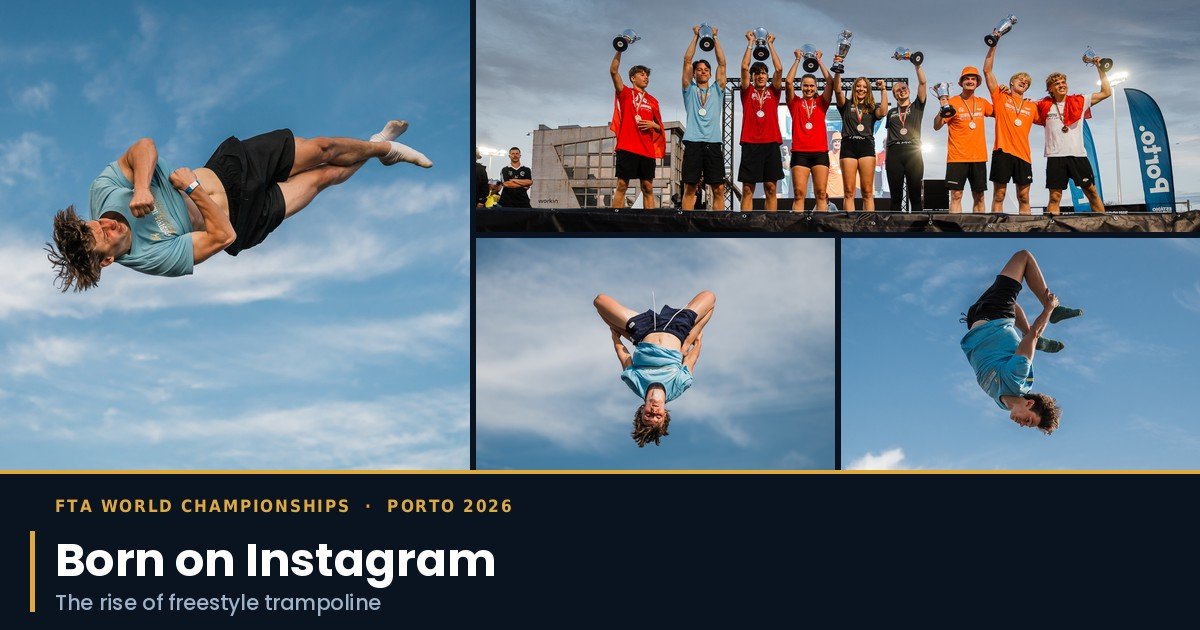
On 23 August 2026, on a beachfront stage in Porto, a 15-year-old from Sweden out-scored every adult in the building.
Alvin Medailleu posted 51.50 to win the Junior World Championship. The Senior Men's champion, Siard Span of the Netherlands, won his title with 49.88. The best run of the entire 2026 Freestyle Trampoline World Championships came out of the 13-15 division.
That is the kind of thing that happens in a sport still writing its own rulebook. Nine years ago freestyle trampoline was a hashtag. Today it crowns world champions in front of a city councillor, runs its own broadcast channel, and has athletes across roughly 30 countries chasing a podium.
So where did it come from? The answer runs from a canvas-and-angle-iron contraption built in an Iowa garage in 1934, through an Olympic medal ceremony in Sydney, to a generation of kids filming themselves in their back gardens.
So whatis freestyle trampoline?
Freestyle trampoline is the action-sports cousin of the Olympic discipline. Athletes link tricks into combos and are judged on three things: difficulty, creativity and execution.
That middle word is the whole point. The FTA puts it bluntly on its own about page: it is not about just throwing crazy tricks, it's about being unique. A run that nobody has seen before can beat a harder run that everybody has.
The comparison the FTA reaches for is snowboarding in the 80s, when riders broke away from classical downhill ski racing and built something with its own tricks, its own language and its own crowd. Freestyle trampoline is doing the same thing to a sport that has been formally coded since the 1960s.
| Olympic trampoline | Freestyle trampoline | |
|---|---|---|
| Routine | Fixed 10-skill routine | Open combos, athlete's choice |
| Judged on | Execution, difficulty, time of flight, displacement | Difficulty, creativity, execution |
| Format | Individual performance | Head-to-head battles |
| Kit | Competition trampoline | Competition stage, garden trampolines, airbags |
| Pathway | National federations | Clubs, parks, social media, open qualifiers |
The culture travels with the format. Competitors call themselves flippers. Qualifiers run out of trampoline parks rather than national training centres. And the sport's shop window was never a stadium — it was a phone screen.
The garage in Iowa: 1930 to 1945
The trampoline exists because a teenager went to the circus.
In 1930, 16-year-old George Nissen watched aerialists in Cedar Rapids, Iowa drop into their safety net and bounce. Everyone else saw a safety device. Nissen saw an apparatus. What if you could keep bouncing on purpose?
Four years later, working with his University of Iowa gymnastics coach Larry Griswold, he built the first one out of angle iron, canvas and inner tubes. The rubber stretched and died, so they swapped it for steel springs. Nissen and Griswold formed the GriswoldNissen Trampoline & Tumbling Company in 1942, and the patent for the "tumbling device" landed on 6 March 1945.
The name came from a road trip. Touring Mexico after graduating in 1937, Nissen heard the Spanish el trampolín — diving board — anglicised it, and trademarked it.
From there it went everywhere:
- World War II. The US military used trampolines to train pilots to reorient themselves mid-manoeuvre.
- The space programme. Through his friendship with Mercury 7 astronaut Scott Carpenter, Nissen invented Spaceball — bouncing players throwing a ball through a hole in a frame. Carpenter called it the best conditioning exercise for space travel.
- Relentless PR. Nissen bounced on a pyramid in Egypt and, famously, alongside a kangaroo in Central Park. His daughter Dian's verdict on the kangaroo: nasty.
Nissen died in 2010 at 96, holding 44 patents. Along the way he had turned a garage prototype into the only piece of sports equipment most people have in their back garden.
Sydney 2000:the sport grows up, and narrows
Trampolining was recognised as a competitive sport in 1962 and spent the next four decades climbing towards the Olympics. It arrived at the Sydney 2000 Games. Nissen was 86, and he was there, with his daughter Dian — herself a champion trampolinist — to watch the thing he built get its medal ceremony.
It was the goal of his life. It also came with a trade.
To make trampolining comparable across nations, the sport had to be pinned down: a set routine length, a published table of difficulty values, a fixed judging panel, a nationalfederation pathway. That is what codification does, and it works. It is why an Olympic trampoline final is one of the most precise things in sport.
But precision is a filter. A trick with no difficulty value is worth nothing to a scoreboard. A style that doesn't fit the routine template doesn't get scored at all. Athletes who wanted to invent rather than perfect started running out of room — and one of them was about to be shown the door.
The backyard revolution
Something was already happening without permission.
Kids on garden trampolines were filming tricks on their phones and posting them. There was no league, no governing body and no prize money — just a feed. Tricks spread between continents in a day. A teenager in Finland could learn a combo from a teenager in California by watching it forty times.
The LA Times gave it the name that stuck in 2017: the sport born on Instagram.
That same year it stopped being only online. Greg Roe and Trish McGeer staged the Garden Trampoline Games in California — the first organised freestyle competition, and for many of the athletes the first time they had met in person the people they had been trading tricks with online for years.
Roe came out of the competitive trampoline world. McGeer came from outside it, bringing experience in building events. Between them they had the two halves of the problem: the skill, and the business of turning a scene into a sport. What they built next is the reason the scene was never simply absorbed into somebody else's rulebook.
Building the FTA: made for athletes, by the athletes
The Freestyle Trampoline Association is the international body for the sport, and it was built to do one difficult thing: add structure without killing the reason people showed up. Its answer is to ask the athletes. Rather than handing down formats and judging criteria, the FTA consults its community on both, then shapes each event around what comes back. The phrase on its own about page is made for athletes, by the athletes.
What that has produced in under a decade:
- 40+ live events a year across roughly 30 countries, from park qualifiers through to the World Championships
- An annual World Championship, running since 2022
- Athlete, coach and club education and certification, so the sport can be taught properly rather than copied off a feed
- An esports project in development, currently being built and tested rather than launched
- Flipping TV, the FTA's own broadcast channel
- A content creator programme, with music licensing cleared for athletes' videos through partner SoundMarket Io
That last point matters more than it looks. This is a sport whose athletes built their own audiences before they had a federation. Clearing the music rights so a flipper can post a run without a copyright strike is infrastructure, in the same way a competition trampoline is.
The governance has grown up alongside it: an executive team, a board, and an advisory committee drawn from athletes, parents, brand representatives, judges and industry figures. The people running the sport are, for the most part, people who compete in it or who raise someone who does.
How a freestyle run is actually judged
Athletes perform combos on a custom 5² EUROTRAMP freestyle trampoline set into a 12-metre stage — kit built for the sport rather than borrowed from it. Runs are scored by a panel split across the three criteria, with a head judge over the top.
The 2026 World Championship panel, led by Head Judge Adam Reynolds:
| Criterion | Judges | What it rewards |
|---|---|---|
| Difficulty | Jake Mueller, Tom Marchant | Raw technical demand of the skills |
| Creativity | Julian Siau, Nico Stary | Originality — what nobody else is doing |
| Execution | Osama "Ossy" Ali, Brin Leben | Control, shape, landings |
Two judges per criterion, and creativity carries the same institutional weight as difficulty. That is the structural choice that makes freestyle freestyle. Copy the hardest run in the world and you still lose points where it counts.
Getting to the panel is open by design. Athletes qualify through official qualifier events at partner trampoline parks around the world — five parks across Switzerland, Sweden, Austria, the USA and France fed one recent edition. There is no national federation gate to pass through.
From a Hackney chapelto a Porto beach
The first Freestyle Trampoline World Championship ran on 4 August 2022 at the Round Chapel in Hackney, London. Sweden's Sebastian Wennmalm took the first world title with 44.7, closing his run with the world's first double flip with a double twist in two opposite directions. Aleksi Sainio of Finland took silver on 44.0, Switzerland's Robin Steiner bronze on 43.0.
From there: London again in 2023, where Steiner won and the first women's World Champion was crowned. Barcelona in 2024. And in 2026, Porto — a full competition week on the Portuguese coast, with the finals attended in their entirety by Rodrigo Passos, Porto City Councillor and President ofÁgora Porto, who presented the trophies himself
2026 World Championship podiums
Junior (13-15)
| Athlete | Country | Score | |
|---|---|---|---|
| Alvin Medailleu | Sweden | 51.50 | |
| Yanick Krienbuehl | Switzerland | 49.72 | |
| Gianluca Zbinden | Switzerland | 42.14 |
Women's (13+)
| Athlete | Country | Score | |
|---|---|---|---|
| Viktoria Derschiewzki | Germany | 45.66 | |
| Marlene Metzger | Austria | 44.46 | |
| Mira Schwalm | Germany | 41.74 |
Senior Men's (16+)
| Athlete | Country | Score | |
|---|---|---|---|
| Siard Span | Netherlands | 49.88 | |
| Milco Abrahams | Netherlands | 49.52 | |
| Levin Simon | Switzerland | 48.02 |
Viktoria Derschiewzki successfully defended her crown. Siard Span took the senior men's title by 0.36 over his compatriot Milco Abrahams. And Alvin Medailleu's 51.50 stands as the highest score of the entire Finals — a junior number at the top of the whole event.
What happens next
A sport becomes real when other people start investing in it. Porto 2026 was built by partners who each solved a different problem:
| Partner | Role at Porto 2026 |
|---|---|
| EUROTRAMP | Official Trampoline Partner — the competition trampoline and stage |
| ACON | Official G-Tramp Partner — the ACON Action Zone on the beachfront, open to the public |
| BERG Toys | Covered travel and accommodation for 20 athletes from around the world |
| BAGJUMP | Official Landing Partner — the public airbag and the Porto stage top-sheet |
| Maya eSIM | Connectivity powering the global livestream |
| SoundMarket Io | Cleared music for broadcast and for athletes' own content |
The broadcast side is moving. The full finals went out live on Flipping TV, the FTA's own channel, with commentary over the stream. An edited broadcast telling the story of the FTA and the emerging sport — with a specific spotlight on the women's category — is in production.
Wider distribution is being actively worked on. Conversations with streaming and sports platforms are underway, and the FTA is not calling any of them confirmed until they are signed.
Where it goes next is partly a question of format. Freestyle trampoline already has what an action sport needs: a circuit, a judging language, a broadcast channel, and a generation of athletes who built their own audiences before anyone offered them one. What it does not yet have is a fixed seat in the wider action-sports calendar. That is the next conversation.
Meanwhile the engine keeps running: 40+ live events a year across roughly 30 countries, park qualifiers anyone can enter, and a 15-year-old in Sweden who just posted the best score at a World Championship. Nine years on from the first Garden Trampoline Games, the sport born on Instagram has a pathway — and the people at the top of it are still young enough to reinvent it twice more.